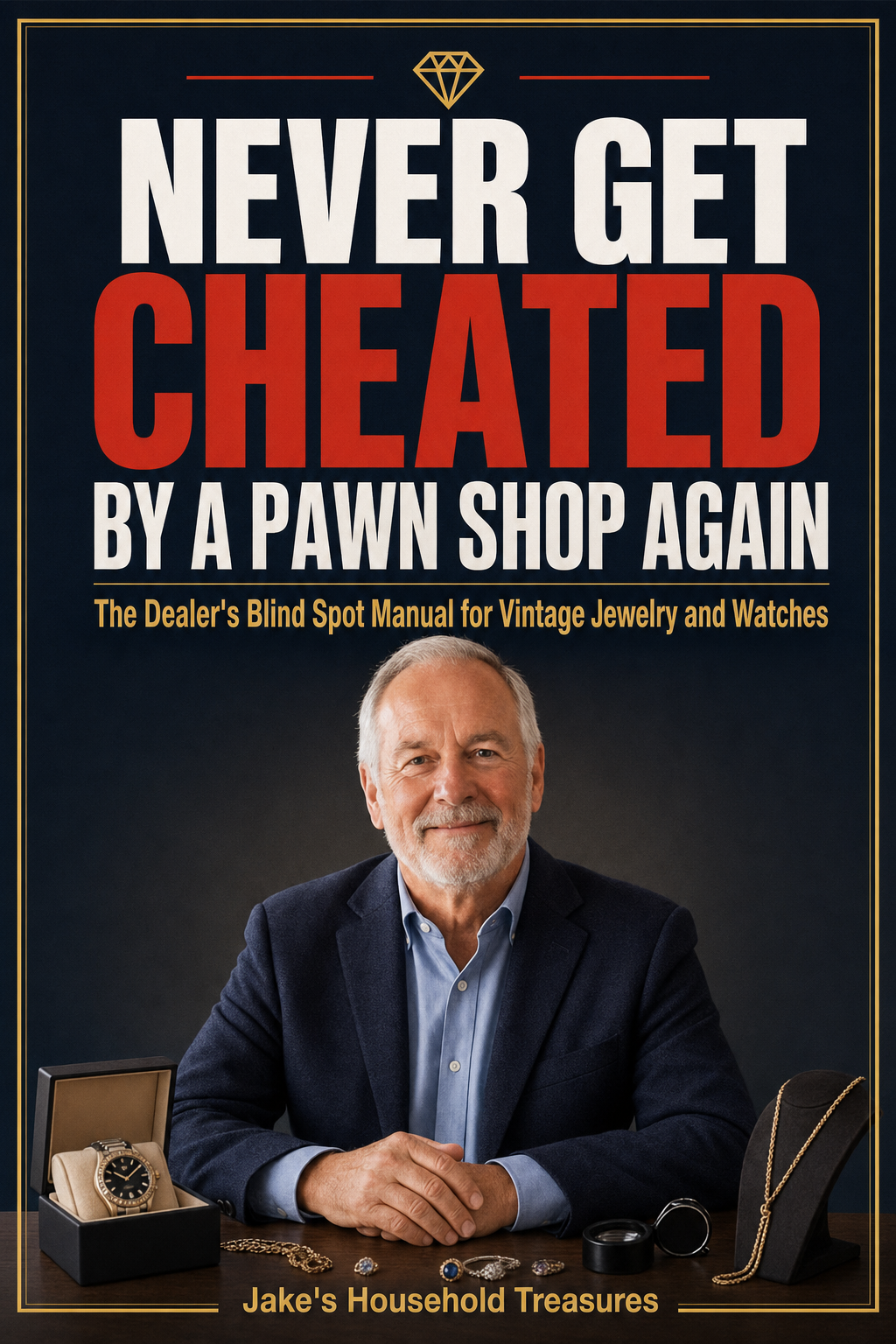
You're standing in a pawn shop. The guy behind the counter just offered you $40 for your grandmother's brooch. You have no idea if that's fair. So you take it. He resells it by Friday for $640.
This book is the education dealers are counting on you never getting.
PDF — reads on any device
They Know What Your Pieces Are Worth. Now So Do You.
30-Day Money-Back Guarantee · Instant PDF Download · No Subscription
The opening case study that shows exactly how the gap between offer price and market value gets created — in one real transaction.
What they look at, in what order, and why that sequence is designed to work against you before you open your mouth.
The stamps, hallmarks, and maker's marks that tell you what the piece actually is — and what the dealer already knows when they read them.
The specific categories pawn shops love most — because uninformed sellers walk them in every week. These are the ones to check first.
How to build a documented price floor using real auction results — so no offer can catch you without a number to compare it to.
Why formal appraisals often cost more than they recover — and the three alternatives that give you the same information for free.
"It's worn." "It needs restoration." What those lines actually justify — and what they don't — when you know the real repair numbers.
Exact language — calm, polite, and devastating — for leaving the counter without leaving money on it.
The dealer offer versus what it sold for. Twelve documented examples. The spreads will change how you walk into every future transaction.
Where to start, what not to touch, and how to sort an inherited estate without accidentally selling the most valuable item first.
...and 13 more chapters across 100+ pages
Jake spent years buying and selling household items — vintage watches, jewelry, silver flatware, decorative pieces inherited from grandparents and great-aunts. He sat on both sides of the counter. He watched dealers offer $25 for a piece they'd list for $280 before the end of the week. He watched sellers walk away grateful — genuinely grateful — for an offer that was a fraction of what the market would bear.
The sellers weren't naive. They were just uninformed. There's a difference. Naive means you couldn't have known. Uninformed means the information existed — it just wasn't in your hands yet. Dealers benefit from that gap. They count on it. And for a long time, closing that gap required either years of experience or a formal appraisal that cost more than some of the pieces were worth.
This book changes that. Before you walk through that door, you'll know how to read the marks on the back of a piece, pull a real auction comparable, recognize a condition-discount argument that doesn't hold up, and respond to a low-ball offer without embarrassment or hesitation. You don't need to become an expert. You need to arrive informed for one specific transaction. That's what these 23 chapters deliver.
Jake's Household Treasures
View Channel →When this offer closes, price returns to $80. The book doesn't change. The price does.
A 14k gold locket from the 1920s sold Heritage Auctions for $480. Average pawn shop offer for the same category: $35–$60. That gap is not an accident.
One read. Yours forever. Covers every piece you'll ever sort, sell, or negotiate — not just the one you're holding right now.
The question is not whether you can afford this. It's whether you can afford another transaction without it.
The following are composite reflections based on common reader experiences. They are not verbatim testimonials.
My mother left me a jewelry box I had no idea how to evaluate. The chapter on coded hallmarks alone changed everything — I realized three pieces I was going to accept $80 for were 18k gold. I walked out with $340 more than the first offer. I wish I'd had this two estates ago.
The Walk-Away Script chapter is worth the price on its own. I've always frozen when someone quotes me a number I'm not sure about. Having the exact words to say — calm, not confrontational — made a real difference the first time I used it at an estate buyer's. He called me back with a higher offer before I reached my car.
The inherited collection audit chapter is exactly what I needed after my father passed. I didn't know where to start. It walks you through room by room, tells you what to photograph, what not to sell in a hurry, and what categories to research before you even pick up the phone. It gave me a plan when I had none.
Take 30 days. Read every chapter. Use the walk-away script. Pull the auction comparables. If after all of that you don't feel more prepared to walk into any dealer, pawn shop, or estate buyer interaction — send one email and get a full refund.
No questions asked. No hoops. The risk is on this side of the counter, not yours.
A 100+ page PDF ebook delivered instantly to your inbox after purchase. It works on any device — phone, tablet, laptop. No app required, no subscription, no account. You download it once and keep it permanently. It includes all 23 chapters, a negotiation script, the auction comparable research method, and the room-by-room inherited collection audit.
Email within 30 days for a full refund. No questions asked. No explanation required. The 30-day money-back guarantee is unconditional. You won't be asked to prove you read it or explain why you want your money back.
Yes. This book is written specifically for people who are not collectors — people who have inherited items or are selling pieces for the first time. You don't need prior knowledge. The entire point of the book is that you don't need to become an expert to protect yourself; you just need to arrive with the right information for this one transaction.
Yes, all three. Chapters 4 and 5 cover gold and silver hallmarks and purity codes. Chapter 8 covers vintage watches. Chapter 6 identifies the eight most commonly undervalued categories, which include jewelry and silverware. Chapter 15 walks you through the fast triage between costume and fine jewelry so you know which items deserve deeper research.
Yes. The dealer psychology, negotiation tactics, hallmark reading, and auction comparable methods apply regardless of country. Some auction platforms referenced are US-based, but Chapter 10 includes methods that work across international auction records. The pricing dynamics described in the book hold in all four markets.
This is a launch offer. The standard price is $80. When the timer on this page runs out, the price returns to $80. The book content is identical either way. If you're on this page now, $47 is available to you — but only through this window.
Every dealer, pawn shop buyer, and estate reseller already has the information in this book. They use it every day, in every transaction, against sellers who walk in without it. That's not a moral failing — it's their job. But you don't have to make it easy for them.
After that, the price returns to $80. The book is the same. The gap between what a dealer offers you and what your pieces are actually worth is also the same. You just won't have the tools to close it.
30-Day Money-Back Guarantee
If the book doesn't help, email for a full refund. No questions asked.